Local Conditions
What Sarasota Air Does to a Rug’s Foundation
Repair work does not arrive at random here. Sarasota spends 259 days a year at or above 75% relative humidity — the level usually quoted as where mold can get started on wool and cotton given enough time — and the longest unbroken run in the five-year record is 72 days. For roughly 10 weeks at a stretch, the cotton foundation under the pile is never offered a chance to dry, and that single fact decides most of what comes through the door.
259
Days a year at or above 75% relative humidity
72
Longest unbroken damp run, in days
0
Nights a year at or below freezing
48.4
Inches of rain a year
A rug with no dry season
259 damp days a year is 70.9% of the calendar, and they do not arrive evenly spaced — the longest single run in the record is 72 days, against a mean relative humidity of 77.8%.
A rug does not care about the yearly figure; it responds to how long it is held above the threshold without relief, because mold is a function of time at humidity rather than of an average.
Wool will carry close to a third of its own weight in water before it feels wet, so by the time a Sarasota rug feels damp the cotton foundation has been loaded for a long while.
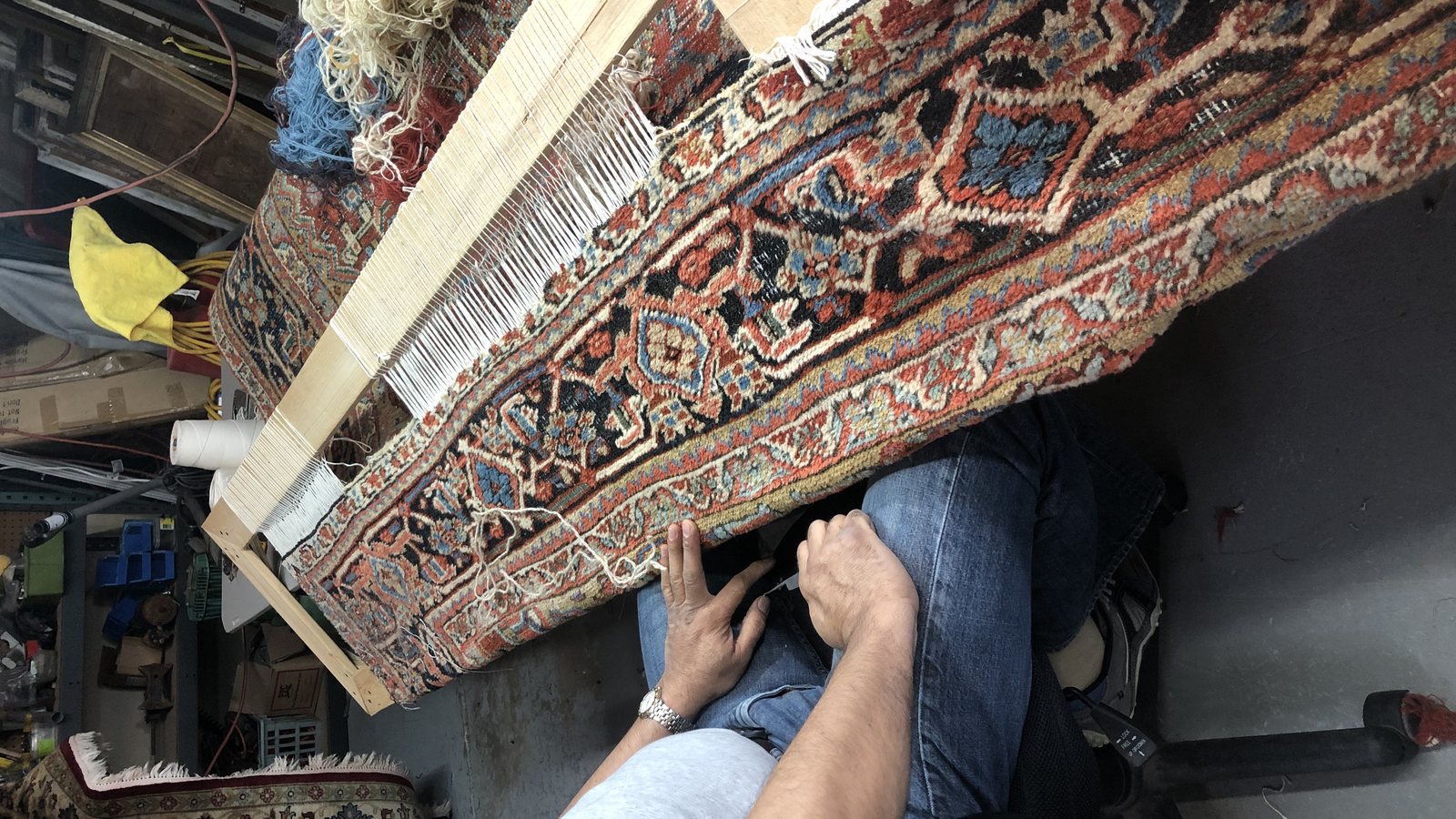
What we see as a result is foundation work rather than cosmetic work: warps rebuilt before any pile goes back in.
Where the house puts the rug
Siesta Key, Longboat Key and Lido Key are substantially condominium stock, which changes the practical half of a repair as much as the technical half.
Units are sealed and mechanically conditioned, so the air is steadier than outside — but a rug rolled and stored in an unconditioned locker or lanai closet is back in the 77.8% mean humidity the moment it leaves the apartment.
Siesta Key, Bird Key and Bradenton River District sit on or near the water, which raises the local moisture load above what a regional figure implies.
Ground water close to the surface keeps the soil under a floor wet through the dry parts of the year, so the 106 days a year when the air is below the mold threshold do less recovering than they look like they should.
The oldest housing on the collection route goes back to the 1910s, and construction of that age was not built to keep ground moisture out of the rooms above it — which is worth remembering before blaming a rug's condition on the rug.
What that actually sends in for repair
Foundation loss, not surface wear
Cellulose held damp loses strength, and 72 unbroken days above 75% is long enough for it to matter.
A foundation going that way gives no cosmetic warning, so the test is mechanical: fold a corner and see whether it flexes or crackles, and pull gently on a fringe tassel to see whether it is still anchored in anything.
Fringe, because fringe is the foundation
Fringe is the warp ends of the rug, not a trim, so 259 days a year of damp working on cotton warps shows up there before it shows up anywhere else.
Once the ends let go the rug starts unravelling from the edge inward, which is why a fringe that has begun to shed is worth dealing with while it is still a fringe job.
Dyes that moved before we saw the rug
183 days a year reach 80% relative humidity, where a wet rug stays wet, and an unstable dye that is kept wet and warm will travel.
Most of what looks like a stain on an old rug is dye that migrated during an earlier soaking, and it is corrected by hand where the fiber is still sound rather than by washing harder.
Figures above are from the ERA5 reanalysis record for the five years from 2021 through 2025,
taken at the center of the the Suncoast service area. If what you are seeing on your rug
matches any of this, send photographs and we will tell you which of these it is.